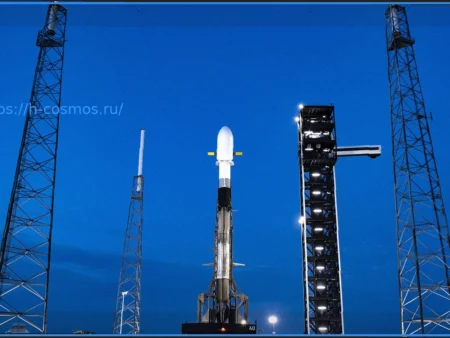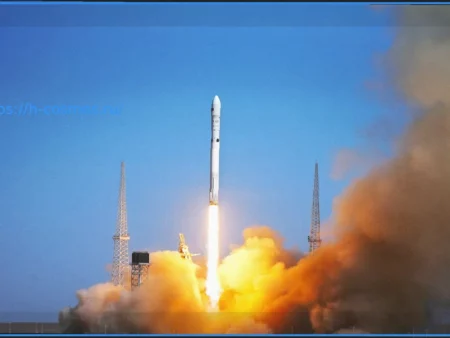

Early Tuesday morning, SpaceX launched a demonstration mission for its Starfall reentry vehicle. Falcon 9 lifted off at 6:53 AM EDT (10:53 UTC) from Space Launch Complex 40 (SLC-40) at the Cape Canaveral Space Force Station in Florida. Weather was 95% “go” for launch, with the only concerns being the cumulus cloud rule.
Riding within a payload fairing atop Falcon 9 was a demonstration version of the pancake-like Starfall reentry vehicle. Following launch, the Starfall vehicle remained attached to the second stage before being deorbited for reentry, ultimately splashing down in the Pacific Ocean just hours after launch.
SpaceX’s Starfall reentry vehicle
SpaceX’s Starfall reentry vehicle is an upcoming mass-produced spacecraft that will autonomously transport payloads safely from orbit to Earth’s surface. The disk-shaped Starfall capsules will have a diameter of 3.1 m, stand only 0.75 m tall, and have a mass of approximately 2,100 kg. Once in service, the reentry vehicles will be capable of carrying payloads of up to 1,000 kg, supporting point-to-point cargo and in-orbit manufacturing services.
The Federal Aviation Administration (FAA) issued a final environmental assessment for the Starfall demonstration missions on May 15, providing, for the first time, information on Starfall and SpaceX’s ultimate plans for the vehicle. The FAA assessment approved SpaceX for no more than two demonstration missions, stating “SpaceX would reenter Starfall through Earth’s atmosphere on a pre-planned trajectory and land (splash down) the capsule in the Pacific Ocean, approximately 700 nautical miles (nm) off the U.S. west coast in international waters… SpaceX would recover vehicle components, including parachutes and heat shields, to the maximum extent practicable.”
According to the FAA, a Starfall capsule is comprised of two halves. The top half, or “top plate,” consists of an “aluminum structure partially wrapped in thermal protection material.” This top plate masses approximately 1,400 kg. The bottom half, the heat shield, features a carbon-fiber structure wrapped in thermal protection material, with two carbon-overwrapped pressure vessels (COPVs) and smaller auxiliary compressed-gas bottles. The heat shield masses approximately 700 kg. After reentry, the heat shield and top plate would separate.
During reentry, Starfall will use an inert gas, likely nitrogen, from within the COPVs to control its attitude. A drogue and main parachute will deploy following the plasma phase of reentry to slow the vehicle to a safe velocity for a splashdown. It is unknown when the separation of the heat shield and top plate occurs relative to the parachute deployments.

Rendering of a Starfall capsule reentering Earth’s atmosphere. (Credit: SpaceX)
SpaceX plans to ultimately mass-produce Starfall vehicles, which are expected to be used in a wide range of applications. One such application of Starfall is its use as a military asset. Starfall’s point-to-point cargo delivery capability could be used by militaries to deliver critical cargo or supplies to conflict zones or underserved areas in need of military support.
Another application of Starfall is in-space manufacturing, most notably for pharmaceutical drugs and advanced material production. Manufacturing these products in a microgravity environment offers several benefits, and Starfall capsules are expected to return them to Earth after they’ve been manufactured in orbit. What’s more, once commercial space stations are operational in orbit, reentry vehicles like Starfall are expected to be used to quickly return items to Earth, rather than waiting for a cargo or crewed vehicle to depart, thereby increasing the cadence of mass returned to Earth.
Starfall demonstration mission
The first Starfall demonstration mission launched on Tuesday, June 23rd, at 6:53 AM EDT (10:53 UTC) from SLC-40 in Florida. Falcon 9 followed a southeast trajectory out of the Cape into a low-Earth orbit (LEO). The launch window lasted for an hour, closing at 7:43 AM EDT (11:43 UTC).
Falcon booster B1078 supported this mission, flying for the 29th time. After stage separation, the booster landed atop SpaceX’s east coast droneship, A Shortfall of Gravitas, downrange in the Atlantic. The booster has previously supported the Crew-6, O3b mPOWER 3 & 4, USSF-124, BlueBird 1 to 5, Nusantara Lima, and 23 Starlink missions.

Rendering of Starfall capsules being deployed from Starship. (Credit: SpaceX)
The Starfall demonstration vehicle stayed attached to the Falcon 9 second stage in LEO for around 1.5 orbits. The second stage then deorbited itself and the Starfall capsule, after which Starfall was jettisoned and prepared for reentry. SpaceX released limited information about the mission, and it is unknown whether the Starfall demonstration vehicle carried any payloads, though instrumentation was likely used to measure reentry forces.
Following reentry, Starfall separated its two halves, deployed its parachutes, and splashed down in the Pacific, approximately 1,300 km off the west coast of the United States.
(Lead image: Falcon 9 launches the Starfall Demo mission from Florida on Tuesday. Credit: SpaceX)

The post SpaceX tests upcoming Starfall reentry vehicle with demonstration mission on Tuesday appeared first on NASASpaceFlight.com.