
This week’s launch manifest includes six orbital launches worldwide, including the first Pegasus XL launch since 2021. SpaceX dominates the schedule with three Starlink missions, the Starfall demonstration mission, and the SXM-11 mission — all of which are to fly on Falcon 9. Internationally, a Chang Zheng 7A launched an unspecified payload on Tuesday.
Chang Zheng 7A | Unknown Payload
The first launch of the week was China’s Chang Zheng 7A (CZ-7A), which launched from Launch Complex 201 (LC-201) at the Wenchang Space Launch Site in China on Tuesday, June 23. The rocket launched at the top of the 50-minute launch window, which began at 02:10 UTC, with the rocket lofting a classified TJSW-26A satellite on an easterly trajectory to a geostationary transfer orbit (GTO).
The CZ-7A is a three-stage expendable vehicle developed by the China Aerospace Science and Technology Corporation (CASC). The 60.13-m tall rocket’s first two stages are fueled by liquid kerosene (RP-1) and liquid oxygen (LOX), while the third stage is powered by two YF-75 engines fueled by liquid hydrogen (LH2) and LOX. The first stage employs two YF-100 engines, and the second stage utilizes four YF-115 engines. The vehicle has a total thrust at liftoff of 7,128 kN and can carry up to 12,000 kg to low-Earth orbit (LEO).
The launch was Chang Zheng 7A’s 16th launch overall and its second mission of 2026.

Chang Zheng 7A rolls out. (Credit:CASC)
Falcon 9 | Starfall Demo
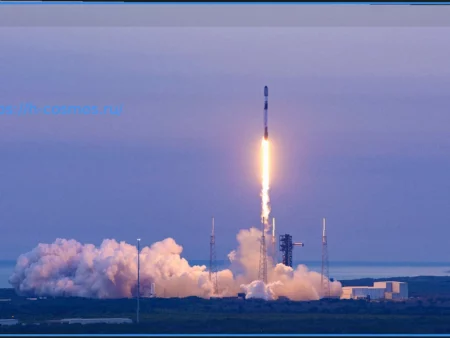
On Tuesday, June 23, SpaceX launched its first Falcon 9 mission of the week from Space Launch Complex-40 (SLC-40) at the Cape Canaveral Space Force Station (CCSFS) in Florida. The one-hour window began at 06:43 AM EDT (10:43 UTC), with the rocket launching at the top of the window on a southeasterly trajectory inclined at 56.1 degrees. Falcon 9 booster B1078 was on its 29th flight. The booster landed on the company’s autonomous droneship A Shortfall of Gravitas (ASOG) downrange in the Atlantic.
The Starfall Demo reentry vehicle will test the autonomous return of customer payloads from Earth’s orbit, a vital capability for in-space research and manufacturing. The vehicle is disc-shaped, 3.1 m in diameter, and 0.75 m in height. The spacecraft can carry up to 1,000 kg of payload into orbit and has a top plate with maneuvering thrusters and a jettisonable heat shield. After a coast of around 1.5 orbits, the vehicle reentered Earth’s atmosphere before SpaceX recovered it in the Pacific Ocean.
While this demonstration will launch on a Falcon 9, SpaceX’s Starship is likely to fly the future Starfall vehicles. Similar reentry vehicles include Varda Space’s Winnebago, which has flown on SpaceX’s Transporter missions.
Falcon 9 | Starlink Group 17-45
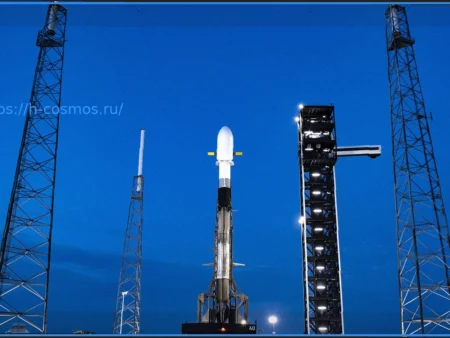
The third mission of the week is a Falcon 9 launch from Space Launch Complex 4 East (SLC-4E) at the Vandenberg Space Force Base in California on Wednesday, June 24. The two-hour launch window begins at 7:48 PM PDT (02:48 UTC). Falcon 9 will launch on a southerly trajectory to a Sun-synchronous orbit (SSO) with a 97-degree inclination, where it will deploy 24 Starlink v2 Mini satellites.
The booster for the mission, B1081, will be on its 25th flight, previously supporting the Crew-7, CRS-29, PACE, Transporter 10, EarthCARE, NROL-186, Transporter 13, TRACERS, NROL-48, CSG-3, and 14 Starlink missions. SpaceX will land the booster downrange in the Pacific using its droneship Of Course I Still Love You.
Falcon 9, the first orbital-class vehicle to be recovered and reused, has two stages. The first stage is 41.2 m in height and is powered by nine Merlin 1D engines, which use RP-1 and LOX as propellants. Falcon 9’s second stage has a single Merlin 1D vacuum-optimized engine that also utilizes RP-1 and LOX as propellants.
The mission will be SpaceX’s 76th mission of the year and 686th overall.

Starlink satellites before deployment in orbit. (Credit: SpaceX)
Pegasus XL | Swift Boost Mission
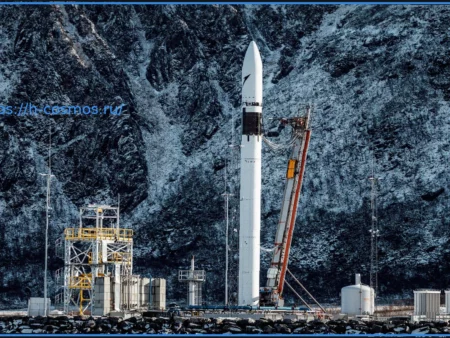
Flying on its first mission since 2021, the Lockheed L-1011 TriStar Stargazer will carry a Pegasus XL rocket to air-launch the Swift Boost Mission for NASA. Stargazer is expected to take off on a southeasterly trajectory from the Ronald Reagan Ballistic Missile Test Site in the Marshall Islands on Saturday, 27 June, with the 5.5-hour launch window beginning at 09:00 UTC.
Pegasus XL is a four-stage vehicle originally developed by Orbital Sciences Corporation and now operated by Northrop Grumman. The vehicle’s first three stages use Hydroxyl-terminated polybutadiene (HTPB) and aluminum as fuel, while the optional fourth stage utilizes hydrazine (N2H4) as its propellant.
The robotic servicing spacecraft for the Swift Boost Mission was developed by Katalyst to rendezvous with and capture NASA’s Neil Gehrels Swift Observatory. The spacecraft was launched in 2004; however, due to atmospheric drag, it is now in a decaying orbit and will reenter unless it is boosted. To this end, NASA contracted Katalyst to develop and build a spacecraft capable of capturing and raising the observatory’s altitude over several months, thereby prolonging its operational life.

Pegasus XL is released from Stargazer on a previous mission. (Credit: NASA)
Falcon 9 | Starlink Group 17-40
A SpaceX Falcon 9 is scheduled to launch a batch of Starlink v2 Mini satellites from SLC-4E at the Vandenberg Space Force Base in California on Sunday, June 28. The vehicle is expected to launch during a four-hour window beginning at 7:00 AM PDT (14:00 UTC).
SpaceX’s droneship Of Course I Still Love You will serve as the landing location for the mission’s booster, B1088, downrange in the Pacific Ocean. The booster will be flying on its 17th mission, having previously supported 13 Starlink missions, Transporter 12, SPHEREx & PUNCH, NROL-126, and NROL-57.
Falcon 9 | SXM-11
The final mission of the week will see yet another Falcon 9 launch from SLC-40 in Florida with the SXM-11 satellite. Liftoff is scheduled for Sunday, June 28, at 10:25 PM EDT (02:25 UTC on June 29) during a three-hour and 56-minute launch window. Falcon 9 will follow a due-east trajectory from Florida, deploying the satellite to GTO.
Falcon booster B1085 will support this mission, flying for the 17th time. Following stage separation, the booster will land on A Shortfall of Gravitas downrange in the Atlantic. B1085 has previously supported the Crew-9, GPS III SV07, Blue Ghost Mission 1, Fram2, SXM-10, MTG-S1/Sentinel-4A, Echostar XXV, and nine Starlink missions.
Manufactured by Lanteris Space Systems and operated by SiriusXM, SXM-11 is the 12th SXM satellite for SiriusXM. The 7,000 kg high-powered, digital, audio radio satellite is based on the IM-1300-class platform and features a 10 m unfurlable mesh reflector. The reflector will allow SiriusXM programming to reach customer radios.
This mission marks the 659th overall Falcon 9 mission, the 76th of 2026, and the 154th orbital launch attempt worldwide in 2026.
(Lead Image: Falcon 9 launches from Florida. Credit: Julia Bergeron for NASASpaceflight)
The post Launch Preview: Pegasus XL to launch amongst Falcon 9 and Chinese missions appeared first on NASASpaceFlight.com.